 My Beast
Discounts and news by email. Unsubscribe in one click.
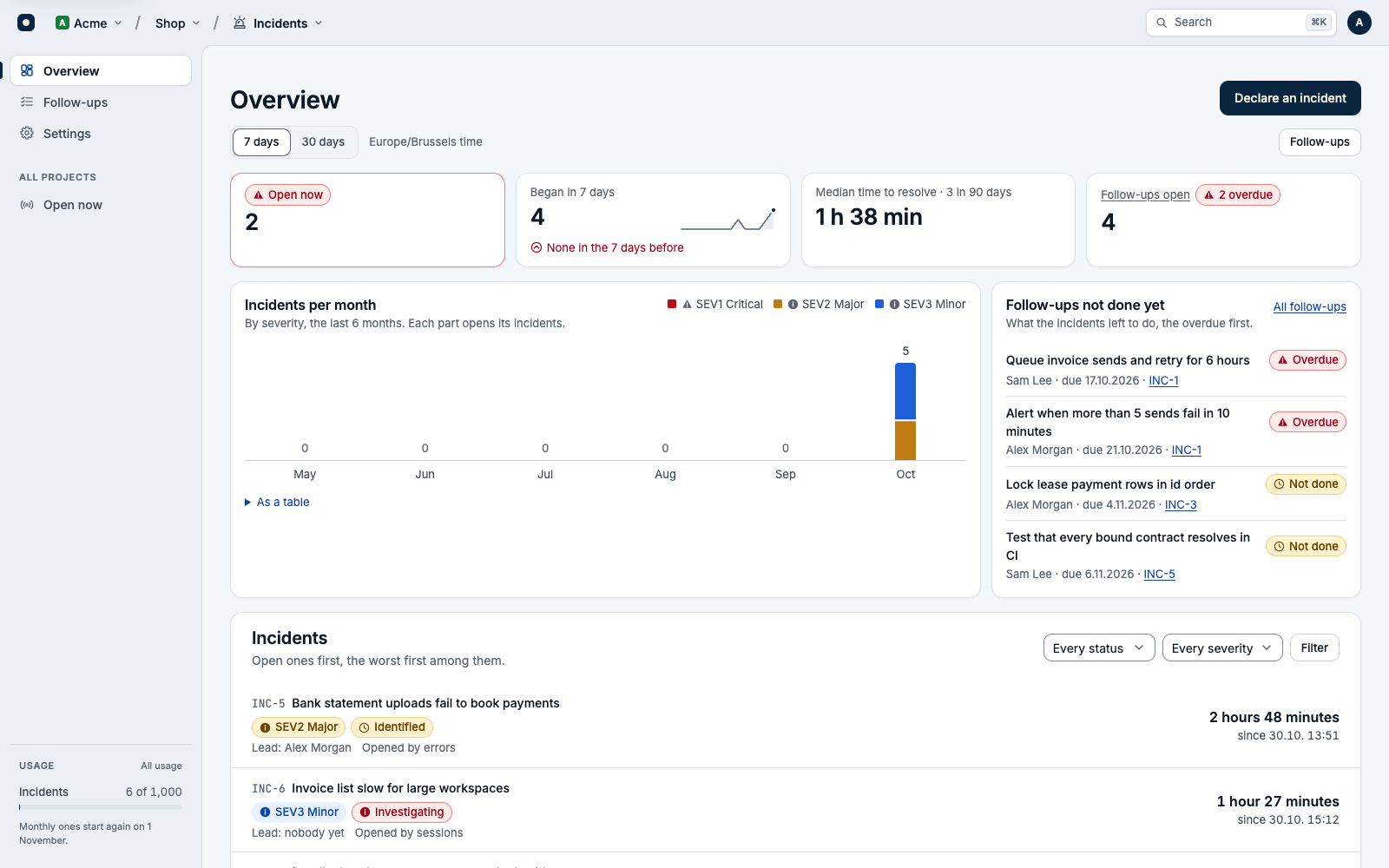
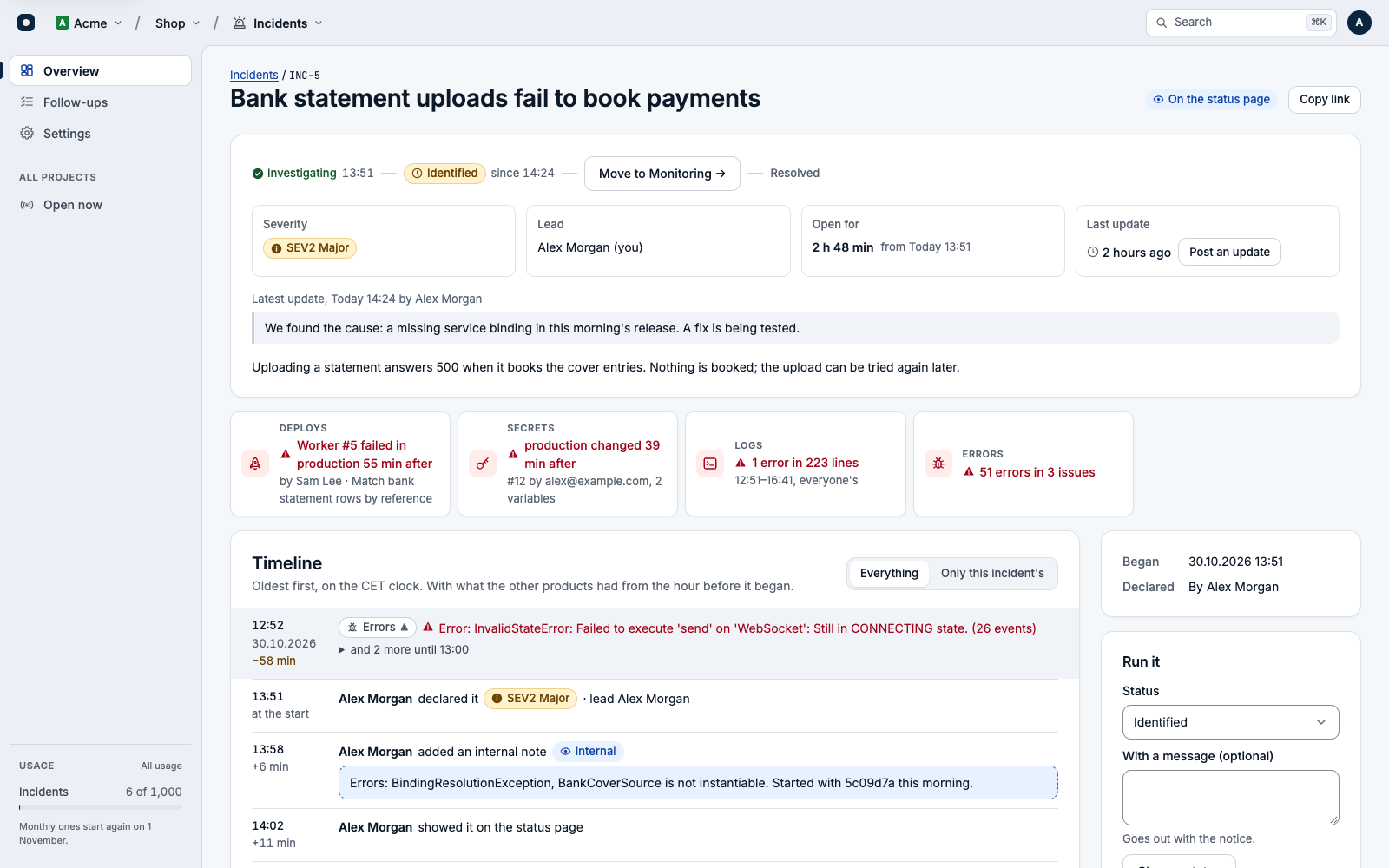
Declare an incident by hand, or from your own systems through the API. Give it a severity and a lead, post updates as it moves from Investigating to Resolved, and your team hears each step by email, Telegram or Slack. Afterwards, keep follow-ups and a write-up on it.
For operations, developers and support.
You sign up and pay for Incidents separately from hosting.
Prices are without VAT: VAT is added at checkout, where it applies. Plans renew each month or year until you cancel. Ask within 30 days of your first payment, or 14 days of a renewal, and you get it back in full. Sold by our reseller Paddle, which handles payment, VAT and invoices. Terms · Refunds
Pick Incidents and a plan, name your project and pay.
Your project's people get email. Add a Telegram chat or a Slack channel in Settings, and send a test.
By hand, with a title, a severity and a lead, or from your own monitoring through the API with a server key.
Post updates and move its status until it is resolved. Then add follow-ups and a write-up.
| Starter€9 a month€90 a year | Team€39 a month€390 a year | Business€99 a month€990 a year | |
|---|---|---|---|
| Incidents a month | 20 incidents | 100 incidents | 1,000 incidents |
Past the plan's monthly limit every incident is still opened, counted and shown as over, never refused.
An internal note never leaves Incidents in a notice. A server key reaches only its own project. A Telegram bot token and a Slack webhook are kept encrypted.
Your plan counts the incidents opened each month, by hand or through the API. Past the limit an incident is still opened, counted and shown as over: it is never refused, because one can start in the middle of an outage. A call that joins an open incident is not a new one, and the count starts again on the 1st.
There is no free plan and no test mode. Settings has "Send a test", so you can see that email, Telegram and Slack reach your team before an outage does.
Uptime checks and heartbeats: an alert when a site or a job stops answering.
For operations, developers and support
Errors from your app and its pages, grouped into issues, with alerts.
For developers and operations
Every app's deploys in one place: who shipped what, the log, rollback.
For developers and operations
Any. Incidents is run in the browser, and anything that can make an HTTPS call can open, update and resolve incidents through the API with a server key, starting with POST /incidents/api/v1/incidents. No SDK is needed.
On our servers in Germany. Incidents, their timelines, follow-ups and write-ups are kept with no end date: nothing removes them on a schedule. The project's audit log is kept for 24 months.
Send a dedupe_key with the call. While an incident with that key is open, a new call adds a line to its timeline instead of opening another, and a worse severity raises it.
The incident's reference, title, severity, status and lead, and each update that is not internal. An internal note stays in Incidents.